Skiing
04. How to Stop on Skis and Start Snowplough Turns
Learning how to stop on skis comes before choosing a longer run. Practise the snowplough, also called a wedge, on very gentle teaching terrain with a clear runout and a qualified instructor.
DYLAN / PRACTICAL SKIING GUIDES
Learning how to stop on skis comes before choosing a longer run. Practise the snowplough, also called a wedge, on very gentle teaching terrain with a clear runout and a qualified instructor.
For beginner alpine skiing on open, managed resort slopes. Use these notes alongside a qualified instructor; they are not a substitute for an on-snow lesson.
1. Agree the practice space first
Ask the instructor to select a very gentle slope with a clear, spacious stopping area. Identify the start and finish points before you move. Check that the whole exercise is visible and that other learners have finished before taking your turn. A quiet-looking run is not automatically an appropriate beginner teaching area.
Discuss what you should do if the exercise does not go as planned. Do not begin at the top of a long run hoping to learn braking on the way down. Being able to slide is different from being able to manage speed and choose where to stop.
2. Learn the wedge without rushing
In the instructor’s flat practice area, bring the ski tips closer while moving the tails apart, without crossing the tips. Keep the legs flexed and weight centred. On a very gentle glide, a wider wedge can increase braking; do not achieve this by squeezing the knees together. Practise a complete stop before repeating.
Treat each short attempt as a feedback loop: start only on the instructor’s signal, make the movement, stop, then describe what happened. If the tips crossed or your weight moved backward, ask for one correction at a time. Do not try to solve poor control by taking a faster run.
3. Introduce turns as a separate learning step
Once stopping is reliable, your instructor can introduce steering both skis through a gentle wedge turn. Slightly more pressure on the outside ski helps: the left ski is outside a right turn and the right ski is outside a left turn. Keep the movement smooth rather than throwing the shoulders around.
Use the shape of the turn to manage speed, with the instructor choosing a safe path and enough room. Practise both directions. If one direction is consistently uncomfortable, explain that before linking a series of turns. The next step is better control, not a narrower wedge at any cost.
4. Use a clear progression check
Before moving away from the learning area, ask the instructor to check whether you can stop on request, turn both ways and respond to other people without losing control. Repeat this check when the snow becomes firmer, the slope becomes busier or visibility changes. A successful attempt on one surface does not guarantee the same result everywhere.
Keep early practice sessions short enough to remain attentive. If you start staring at the ski tips, bracing the whole body or repeatedly missing the intended stopping point, pause for feedback. Rest and a simpler exercise can be more useful than another run on the same terrain.
Your next-session checklist
- Identify the practice boundary and stopping area with your instructor before starting each glide.
- Learn a small wedge on the flat: tips closer, tails wider and skis not crossed. Keep a balanced, flexible stance.
- Practise short glides, controlled stops and then turns in both directions. Change terrain only when your instructor agrees.
Ready check: You can repeat a controlled stop within the agreed area and finish easy turns in both directions without relying on someone to catch you.
Stop and reassess: Return to simpler terrain if speed builds unexpectedly, the skis cross repeatedly, you cannot stop where intended or fear prevents you from following instructions.
Common questions
Is the snowplough only for children?
No. A wedge can be a useful beginner learning tool for adults too. Your instructor will choose the progression that suits you.
When can I try a steeper slope?
When your instructor has assessed your stopping, turning and awareness for that specific terrain and the current conditions. Confidence alone is not the test.
Sources and further learning
Published 26 October 2026. Editorial preparation notes compiled from the resources above; no personal coaching or medical assessment is implied.
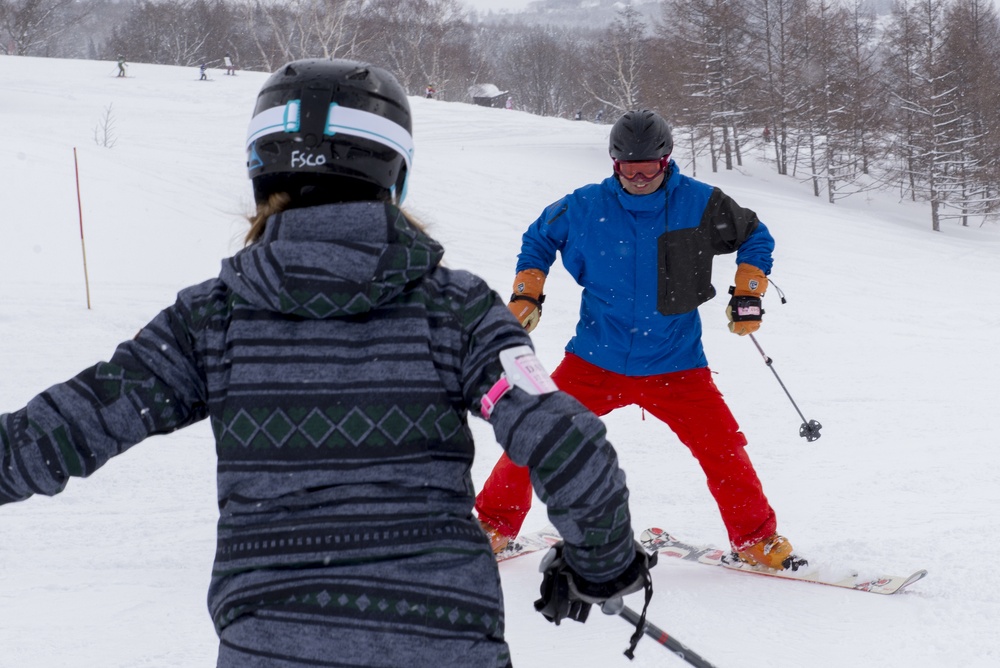
Supervised skiing practice. Photo: Donald Hudson / U.S. Air Force, public domain. Copy the instructor’s teaching, not a still photograph. Photo source.
Explore all 6 skiing guides ↗ · Skiing BLOG ↗
Continue learning: 05. Ski Slope Safety and Chairlift Basics ↗