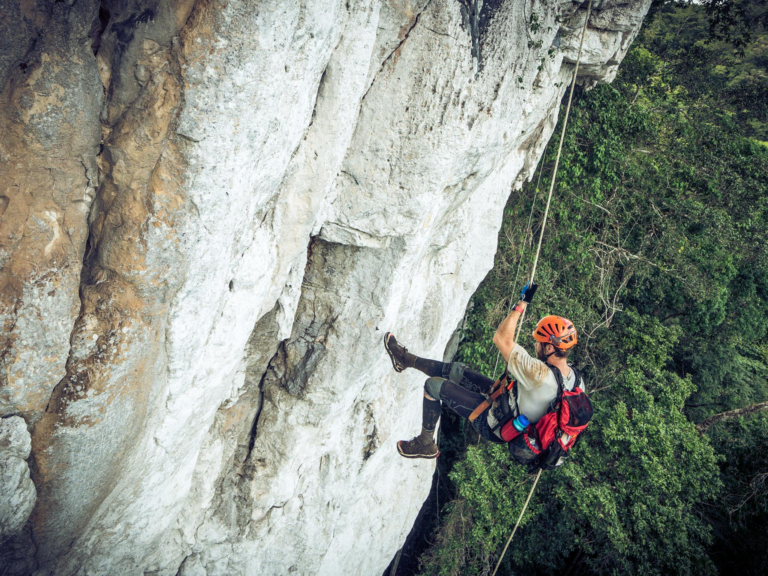
Rock Climbing
02: Mobilise shoulders, wrists, hips & ankles
Use small, smooth movements to explore the range you will need on the wall. Keep both feet on stable ground for this stage.

Practical climbing guide 02 of 08. Use small, smooth movements to explore the range you will need on the wall. Keep both feet on stable ground for this stage.
Use this preparation guide alongside qualified instruction. Rope-system checks are for trained climbers and belayers; beginners need instructor supervision.
Shoulders and wrists
Stand comfortably with room on both sides. Make small arm circles, then enlarge them only while the shoulders remain comfortable. Reverse the direction. With elbows relaxed, make slow wrist circles rather than wrenching the wrists with your other hand. Use a few repetitions to assess comfort; the goal is rehearsal, not a maximal stretch.
Hips and ankles
Hold a stable support if balance is uncertain. Lift one knee to a comfortable height and move it gently outward, then return it to the starting position without twisting the supporting knee. Lower the foot and repeat on the other side. For the ankle, keep balance supported and draw small circles with the free foot. Finish by bending into a shallow, controlled squat, heels supported on the ground.
Choose quality over range
You do not need to reach an extreme position to prepare for climbing. Keep movements slow enough to stop at any point. A comfortable first round is more useful than forcing a fixed number of repetitions. If one movement feels wrong, leave it out and ask your instructor for an appropriate alternative.
Transfer the movement to the wall
After the safety checks, use an easy supervised route to try small steps and comfortable reaches. Do not use a difficult high step or deep knee twist as a flexibility test. For recurring pain, a previous injury or restricted motion, seek advice from a qualified clinician rather than repeating a painful drill.
Ready to continue?
You can reach, turn and bend without pain or forcing the joint.
Stop and reassess
Do not bounce into end range or force a stiff joint. Reduce the range or stop if movement hurts.
References & demonstrations
DYLAN editorial preparation series. Updated October 2026. Exercise examples should be adjusted to your ability; this is not a medical rehabilitation plan.